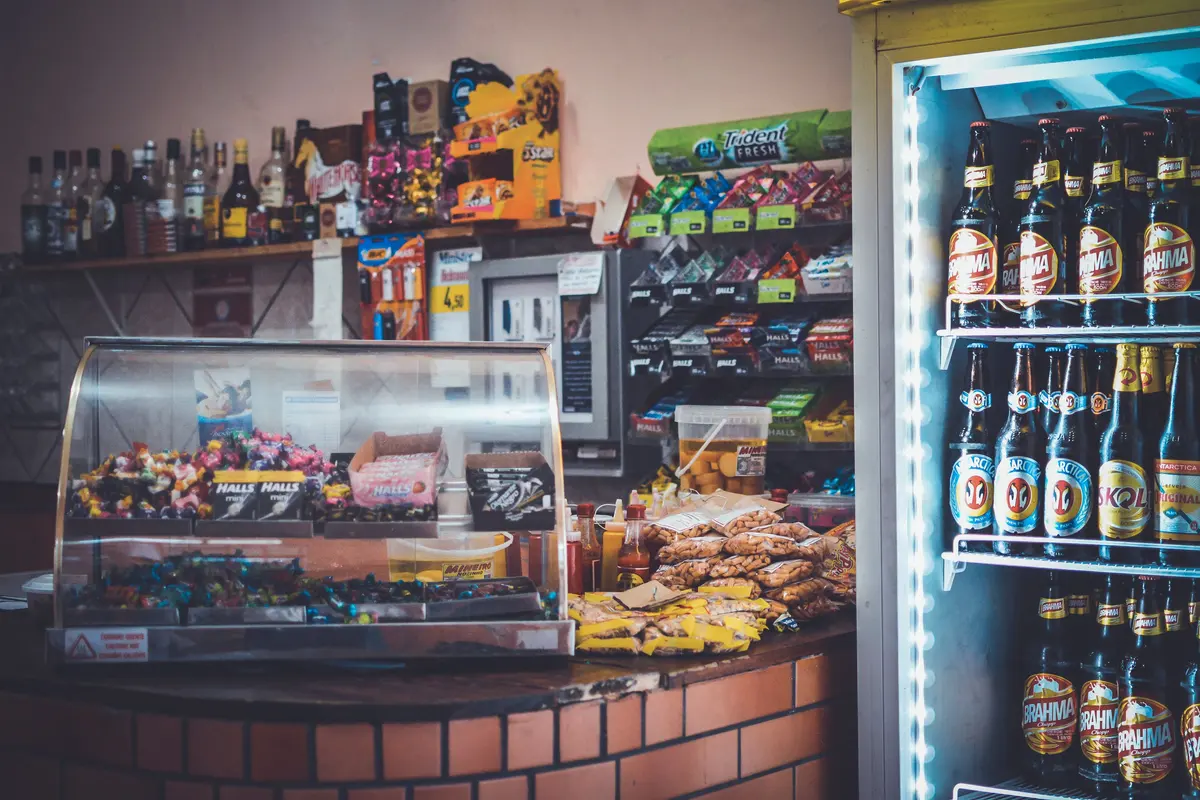
Inventory and business personal property, liquor liability where the list of available license types differs between neighboring counties, refrigeration and spoilage, crime, and workers compensation from a single employee.
Nate is a Chartered Property Casualty Underwriter and the founder of Wexford Insurance, LLC. He places convenience store programs across 48 states — inventory and business personal property, the liquor liability the GL form excludes, crime and cash-handling, and the workers compensation that store staffing triggers. Reach him via the Gas Station Guard Insurance quote form or call 317-942-0549.
Last updated · Reviewed by Nate Jones, CPCU
Kentucky does not sort its territory into two categories. It uses three — wet, dry and moist — and the third one is where the useful detail lives. In a moist territory the only license types that may be issued are those corresponding to the types of sales that were approved there. The status does not simply switch alcohol on; it produces a menu, and the menu differs from place to place.
That matters commercially in a way a wet-or-dry map cannot show. Two moist counties can permit genuinely different things, so an operator running several Kentucky stores may hold different license types at each and may find that a format working in one location cannot be replicated forty miles away. The constraint is not on the business; it is on which licenses exist to apply for.
Carriers do not underwrite convenience stores as generic retail. The class carries robbery and burglary frequency above strip retail, premises claims that behave more like restaurant claims, refrigeration failures landing on stocked perishables, and the regulatory exposure of age-restricted sales. Kentucky adds ice storms and flooding through the river valleys, and long distances across the east where terrain rather than mileage sets response times.
This page covers the Kentucky store: what moves premium here, what a three-way territory system does to a multi-site operator, the coverage lines in a typical program, a compensation duty that reaches almost every employer, the claims we see, and the underwriting realities that decide appetite. Fuel-dispensing sites layer the petroleum lines on top.
48
States licensed (all except Hawaii and Alaska)
20+
Specialty markets in our c-store panel
1–2 hr
Quote turnaround during business hours
C-store
Class-focused agency, not generic retail
What Kentucky convenience store insurance costs
We do not publish premium ranges, because a c-store premium is built from the operation rather than a state average. These are the drivers that move the number on a Kentucky store.
Which license types the store actually holds: On a multi-site Kentucky schedule the permissions can differ store to store, so a single assumption applied across the portfolio will misprice part of it.
Flood position in the river valleys: Flood sits outside the property form. Along the Ohio and its tributaries it is the peril most likely to close a store, and the decision is often made by omission.
Ice storm exposure: Kentucky sits where winter systems stall, and accumulation loads canopies and signage designed for wind rather than weight.
Terrain and response time in the east: Distances in eastern Kentucky are measured in time rather than miles, and that changes how a fire or a robbery develops before help arrives.
Prepared food operations: A hot case or deli brings product liability and cooking equipment onto the program and widens the injury pattern.
Any employee at all: The compensation duty reaches employers with one or more employees, so the line is on the program from the first hire.
Protective safeguards: Camera coverage, drop safes and lit entrances feed the crime rating, and matter more where response times are long.
A third status, and a menu rather than a switch
Kentucky territory can be wet, dry or moist. The first two behave as the names suggest. The third is a partial status, and the statute is specific about how it works: in a moist territory, the only types of licenses that may be issued are those that directly correspond with the types of sales approved within that territory.
The consequence is that moist status describes a list rather than a condition. What is available in one moist territory is whatever was approved there, and what is available in the next one is whatever was approved there — which need not be the same list. A license type that exists a county away may simply not be issuable where your store stands.
The license classes themselves are drawn with some precision, which shows how granular the menu can get. A limited restaurant license, for example, requires premises whose usual and customary business is preparing and serving meals, a bona fide kitchen, at least seventy percent of food and alcoholic beverage receipts from food, a minimum seating capacity of one hundred, and location in a wet or moist territory — and it does not authorize package sales at all.
For an operator with more than one Kentucky store the practical instruction is to describe each site’s permissions individually rather than describing the company’s. A schedule that says “Kentucky, beer and wine” is describing an average that may not correspond to any actual location, and the liquor liability limit is being set against a portfolio picture rather than the store where a claim will happen.
Coverage lines for a Kentucky convenience store
Property and business personal property: Building if owned, plus inventory, coolers, shelving, POS hardware, signage and canopy, with ice loading and river-valley flood position the two things looked at first.
General liability: Third-party injury and property damage on the sales floor, at the entrance and across the lot, including surface conditions through an ice event.
Liquor liability: The general liability form excludes alcohol-related bodily injury and property damage. On a multi-site Kentucky schedule the limit should reflect what each location is actually licensed to sell rather than a company-wide assumption.
Crime and employee dishonesty: Money and securities, robbery, burglary and employee theft, with eastern and rural sites banking less often than the limit usually assumes.
Spoilage and equipment breakdown: The failed refrigeration unit and the stock behind it, as separate agreements — and an ice storm outage takes both together.
Cyber liability: Card compromise at the register and the pump, ransomware, and the interruption that follows an outage.
Workers compensation: Statutory coverage from one employee, with the only meaningful exception reserved for persons engaged solely in agriculture.
Workers compensation for Kentucky store employees
Kentucky requires any person other than one engaged solely in agriculture that has one or more employees subject to the chapter to comply with the workers compensation provisions. For a convenience store there is effectively no threshold to reason about — a single employee brings the business inside the Act.
The agricultural exception is genuinely narrow, applying to persons engaged solely in agriculture. It is not a partial exemption for a business that happens to have an agricultural component, and nothing about a retail store payroll approaches it.
What this means in practice is that the compensation conversation in Kentucky is not about whether coverage is required but about how the risk is managed. The injury pattern for this class is consistent: lifting deliveries, slips behind the counter and in the walk-in, cuts where food is prepared, and injuries arising during a robbery. Where a store keeps long hours on thin staffing, the last of those carries more weight than the frequency alone suggests.
Kentucky convenience store claims we see
A schedule rated on the wrong permissions
The company holds different license types at different stores and the program assumed one. The mismatch surfaces when a claim arrives at the location the assumption did not describe.
Flood loss in a river valley with no flood cover
The property form does not respond. Along the Ohio and its tributaries this is the peril most likely to close a store for an extended period.
Ice loading on canopy and signage
Structures engineered for wind take a load they were never designed for, and an extended outage frequently arrives behind it.
Extended outage taking the perishable assortment
The building survives and the coolers do not. Spoilage and business income carry that loss.
Robbery at a store with long hours and thin staffing
The clerk injury and the closure typically cost more than what was taken, and eastern terrain lengthens the response.
An injury to a single part-time employee
There is no threshold here. One employee brings the store inside the Act, and stores that reasoned from headcount rather than from the statute are the ones that find out afterwards.
The Kentucky c-store risk profile
Kentucky’s property risk is shaped by water and ice more than by wind. The river valleys carry flood exposure that the property form excludes entirely, and winter systems that stall over the state produce ice accumulation on structures built for other loads. Both tend to arrive with extended outages, which pushes the loss into spoilage and business income rather than into repair costs.
Geography splits the trade. The Louisville, Lexington and northern Kentucky corridors run on customer volume and hours. The east runs on terrain — a store may be ten miles from help by the map and considerably further in practice, which lengthens every kind of incident. The west and south sit between the two.
The licensing layer is the state-specific one, and its significance is that it defeats a portfolio assumption. Most states let an operator describe the company once. Kentucky’s three-way status means the list of license types available differs by location, so the accurate description is per store. That is a small administrative point that turns into a real mispricing if a schedule is built the usual way.
The same point bears on acquisition and expansion, which is where it usually costs money. An operator buying a second or third Kentucky store cannot assume the format that works at the first will transfer, because the license type underpinning it may not be issuable at the new address. A site that looks identical on paper — same size, same fuel arrangement, same trade area profile — can support a materially different product mix, and the difference is not visible from anything about the property itself. It is worth establishing what a target site may actually be licensed for before the purchase rather than after it, and worth telling an underwriter which of your stores are operating on which basis rather than letting a single line describe them all.
Why Kentucky c-store owners work with Gas Station Guard Insurance
We place convenience store programs across 48 states and write Ohio Valley petroleum and c-store risks routinely, so a Kentucky submission records each site’s own permissions rather than a company-level summary, along with flood position, ice protection detail, and the staffing pattern that decides how a robbery claim develops.
As an independent agency we place to carriers with appetite for the class rather than to a single company. Where a Kentucky store sits behind a forecourt, the petroleum and retail lines are written as one program rather than two policies with a seam between them.
Kentucky convenience store insurance FAQs
What does “moist” mean for my store?
It means a partial status rather than a yes or a no. In a moist territory the only license types that may be issued are those that directly correspond with the types of sales approved within that territory — so moist status describes a list of available licenses rather than a general permission.
Can two moist counties allow different things?
Yes, and that is the practical point. What is issuable in one moist territory is whatever was approved there, and the next territory may have a different list. A license type available a county away may not exist where your store stands.
How specific do the license classes get?
Quite specific. A limited restaurant license, for instance, requires a bona fide kitchen, at least seventy percent of food and alcoholic beverage receipts from food, a minimum seating capacity of one hundred, and a wet or moist location — and it does not authorize package sales at all.
We have several Kentucky stores. How should the schedule read?
Site by site. Record each location’s own permissions rather than a company-level summary, because a portfolio description is an average that may not match any real store. A liquor liability limit set against the average is being set against a location where no claim will happen.
Do we need workers compensation for one employee?
Yes. Any person other than one engaged solely in agriculture that has one or more employees subject to the chapter must comply with the workers compensation provisions. There is no headcount to reach.
Is flood included in our property policy?
No. Flood is excluded from the property form and arranged separately. In the river valleys it is the peril most likely to close a Kentucky store for a meaningful period, so it deserves a deliberate decision rather than an assumption.
Why do you ask about ice rather than snow?
Because the failure mode is different. Snow is a loading problem the structure usually handles. Ice accumulates on canopies, signage and lines that were engineered for wind, and it typically brings an extended power outage with it — so the claim reaches the coolers and the closed days as well as the structure.
Does a standalone Kentucky c-store need pollution coverage?
Not usually, where there is no fuel dispensing and no storage tank on site. Pollution and storage tank liability are petroleum lines. A standalone store carries the retail stack described here without them, which is part of why standalone and fuel-attached stores go to different carrier panels.